
Tour Date:
April 13-19, 2026.
Tour Price (Per Person):
$2330 based on a group of a minimum of 3 clients. Single supplement $225. Includes transport, food (except day 1), hotels, and guiding by Gunnar Engblom and local guides. Drinks and tips are not included.
Tour Type:
Easy birding. Small group of max 7 people.
Birding Jordan and Petra - Description
Although a peace process is in place for Gaza, it is likely that many general tourists still feel wary about the Middle East. The usually very crowded Petra site has seen very few tourists during the Gaza war. Now would be a good time to visit the world heritage site and one of the new 7 Wonders. Jordan is not in conflict with anyone, and the country is considered very safe.
7WB has, for a long time, had Jordan as a very short extension to our Egypt trip, but it is worth expanding the tour, especially since the birds of Israel are likely not on the birders’ radar right now. The migration in April will be very interesting. Most clients will be coming on this tour because of the chance of seeing Petra without the huge crowds, but the birding will still be very good with several of the resident and migrant bird species new to you, if you have not visited this region before.
The tour includes desert birding in Dana, Azraq Wetlands, Shaumari Wildlife Reserve, Ajloun, Yarmouk Forest Reserves, and the Dead Sea.
Cultural highlights apart from Petra itself include the Roman Theatre and the Citadel in downtown Amman, the crusaders’ castles and fortresses at Shoubak and Azraq, the Byzantine and Roman mosaics in Madaba, and the baptism site of Jesus Christ on the Jordan River.
The birding will be in the early morning and afternoons, and cultural visits will mostly be during the heat of the day, except at Petra, where we will make some early morning hikes to some of the most exclusive archeological sites while also looking for birds.
Try some typical Jordanian food that include:
Mansaf:
Lamb cooked in a sauce of fermented dried yogurt (jameed), served with rice or bulgur, and often garnished with nuts and parsley. It’s considered the national dish and is a centerpiece of celebrations.
Maqluba:
A layered dish of rice, vegetables (often including cauliflower, potatoes, and eggplant), and meat (usually lamb or chicken), which is flipped upside down when served.
Zarb:
A Bedouin specialty, where meat and vegetables are slow-cooked in an underground pit, resulting in a smoky, tender meal.
Mujadara:
A simple yet satisfying dish of lentils, rice, and spices, often enjoyed as a comforting everyday meal.
Kousa Mahshi:
Stuffed zucchini, a popular part of the “Mahashi” family of dishes, which also includes stuffed eggplant, peppers, and tomatoes.
There are also many small dishes often served Meze style, such as Hummus, Falafel, Baba Ghanoush: An eggplant dip, often featuring tahini, garlic, and lemon juice. Tabbouleh: A salad made with parsley, tomatoes, mint, onion, and bulgur. Kibbeh: A dish made with bulgur, minced meat, and spices, and Labneh: A strained yogurt, sometimes used in jameed for Mansaf or enjoyed as a spread.
Jordanian cuisine is very varied, and there are great options for vegetarians.
Entrance fees are not included, since one can acquire the Visit Jordan Pass, which includes the VISA and the entry to most sites, including Petra. Choose the Visit Jordan pass for three days at Petra since we will have an afternoon, a full day, and the following morning with the archeological complex. Most Western travelers obtain their tourist Visa at entry. Having it arranged via the VISIT JORDAN PASS takes care of the obligatory visa fee.
DETAILED ITINERARY
Birding Jordan and Petra Itinerary
Day 1. Fly to Amman.
We will meet up in the evening at our Amman Hotel close to the Roman Theatre and the Citadel in downtown Amman. It is best to arrive early to have the chance to explore the streets before we all meet up. Night in Amman.
Day 2. Drive to Petra via Dana
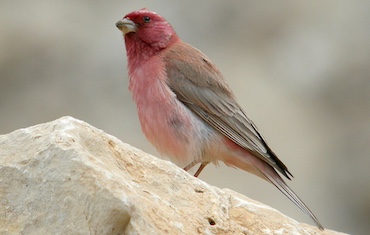
After an early start from Amman, we will reach Dana Biosphere Reserve which has a nice trail system to search for species such as Sinai Rosefinch and Tristram’s Starling, and we will also look out for Syrian Serin and Pharaoh Owl.
We will arrive at Petra in the afternoon to visit some sites and also start looking for other desert birds.
Day. 3. Petra all day.
Famous for its rock-cut architecture and water conduit system, Petra is also called the ‘Rose City’ because of the color of the stone from which it is carved. Access to the city is through a 1.2-kilometre-long (0.75 mi) gorge called the Siq, which leads directly to the famous Al-Khazneh structure, believed to be the mausoleum of Nabataean king Aretas IV. It was constructed in the 1st century AD, when Petra flourished and its population peaked at an estimated 20,000 inhabitants
The Nabataeans were nomadic Arabs who invested in Petra’s proximity to the trade routes by establishing it as a major regional trading hub.
The trading business gained the Nabataeans considerable revenue and Petra became the focus of their wealth.
The Nabataeans were accustomed to living in the barren deserts, unlike their enemies, and were able to repel attacks by taking advantage of the area’s mountainous terrain. They were particularly skillful in harvesting rainwater, agriculture, and stone carving.
Although the Nabataean kingdom became a client state of the Roman Empire in the first century BC, it was only in 106 AD that it lost its independence. Petra fell to the Romans, who annexed Nabataea and renamed it as Arabia Petraea. Petra’s importance declined as sea trade routes emerged, and after an earthquake in 363 that destroyed many structures.
In the Byzantine era, several Christian churches were built, but the city continued to decline, and by the early Islamic era, it was abandoned except for a handful of nomads. It remained unknown to the world until it was rediscovered in 1812 by Johann Ludwig Burckhardt.
It has been a UNESCO World Heritage Site since 1985. In 2007, Al-Khazneh was voted one of the New 7 Wonders of the World. Petra is the symbol of Jordan, as well as Jordan’s most-visited tourist attraction. Tourist numbers peaked at 1.1 million in 2023, while in 2024, as a consequence of the Gaza war, only 457 000 people visited.
Masked Shrike, Fan-tailed Raven, Palestine Sunbird, Scrub Warbler, White-spectacled Bulbul , Desert Lark, should be easy around here, while Sand Partridge is less common.
Night in a hotel near Petra
Day 4. Drive to Azraq.
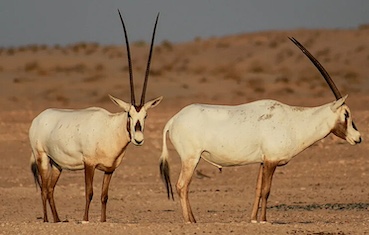
In the morning, we will make a final exploration of the Petra complex and look for more birds. At midmorning, we will travel to Azraq via the 12th-century Mountreal Castle near Shoubak. We will continue to the Azraq Wetlands to look for Greater Hoopoe-Lark, Crested Lark, Graceful Prinia, Great Reed-Warbler, and Rufous-tailed Scrub-Robin. If time permits, we will also make a safari into the Shaumari Wildlife Reserve for a first sighting of the introduced Arabian Oryx.
Day 5. Shaumari Wildlife Reserve and drive to Ajloun and Yarmouk Forest.
Apart from Arabian Oryx and Dorca’s Gazelle, we will look for birds like Desert Wheatear and Cream-coloured Courser.
Around midday, we continue to Ajloun Forest Reserve and Yarmouk Forest Reserve.
Target birds here include Eurasian Jay, Syrian Woodpecker, Levant Sparrowhawk, Masked Shrike, Lesser Kestrel, and Great Spotted Cuckooo.
Day 6. Ajloun Forest to the Dead Sea.
We continue to bird the forests around Aljoun in the morning. On the way to the Dead Sea, we shall visit the Greco-Roman site of Jerash, and then continue to the Babtism site of Jesus Christ on a tributary to the Jordan River.
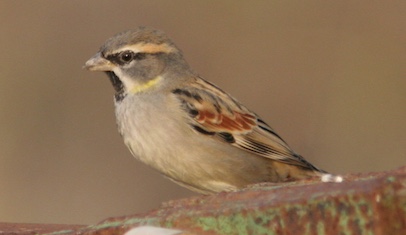
We will check in at out hotel near the Dead Sea and have time for an obligatory dip in the Dead Sea, before the afternoon search for the Dead Sea Sparrow. One of the sites with the most frequent sightings is the tamarisk creek at Suywama. We will spend considerable time here.
Day 7. Dead Sea to Amman.
We continue to look for Dead Sea Sparrow in the morning, if necessary, and then make an excursion to Madaba for the impressive Byzantine mosaics on the way back to the Amman Airport.
We should arrive at the airport just before noon to be able to catch the first international flight from 1:55 pm onwards.